
Compliance Business Ideas: Why Audit Readiness Is an Operations Market
Trend Seeker found 197 compliance-readiness ideas backed by 3,564 distinct signals. The clearest gaps are launch controls, audit evidence, and customer assurance.
15 min read
Introduction
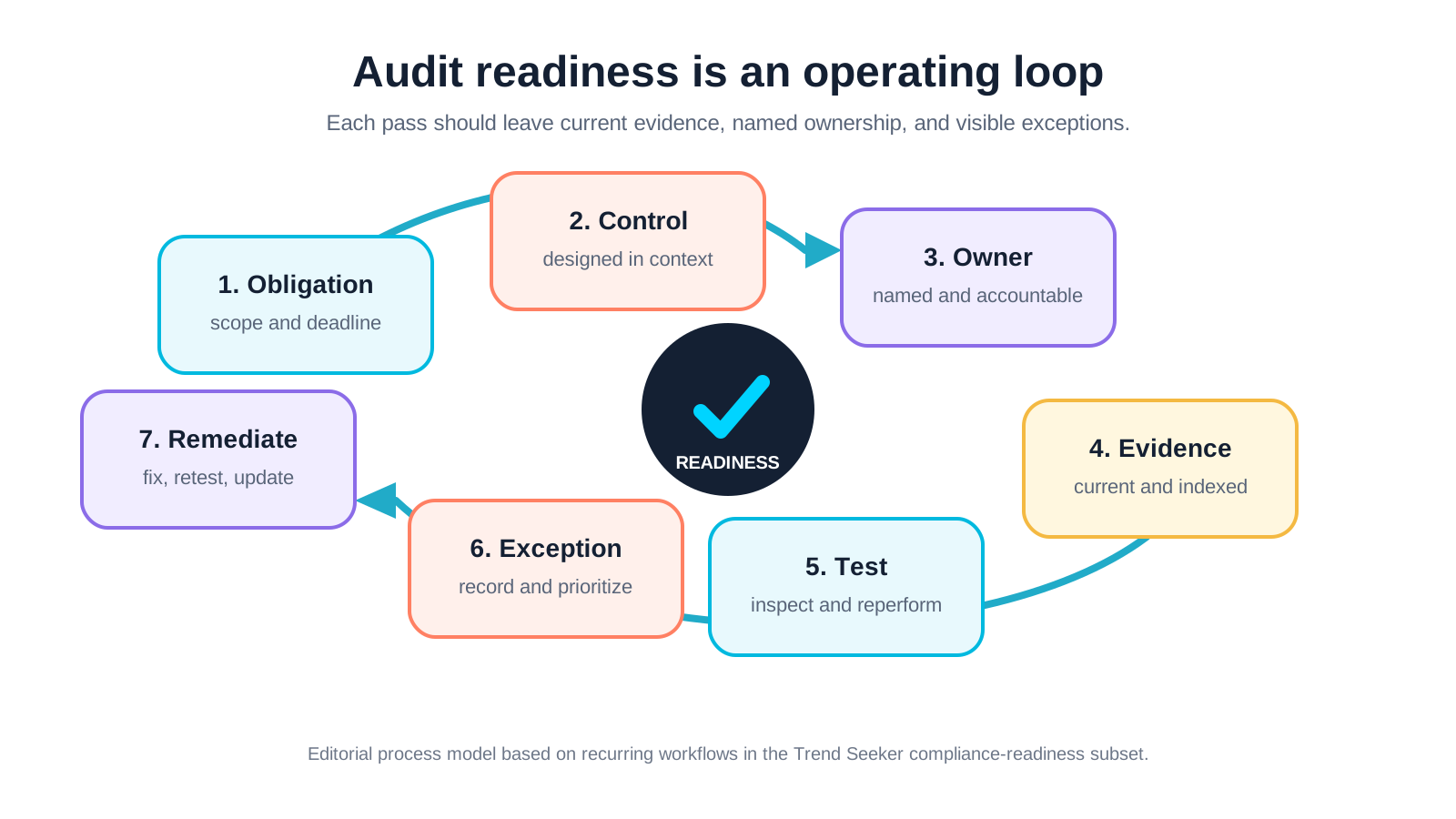
The best-supported compliance business ideas do not sell regulation summaries. They install and maintain the operating proof behind a launch, audit, or customer review. The recurring work is concrete: translate obligations into controls, assign owners, collect evidence, test whether the controls work, track exceptions, and keep the record current.
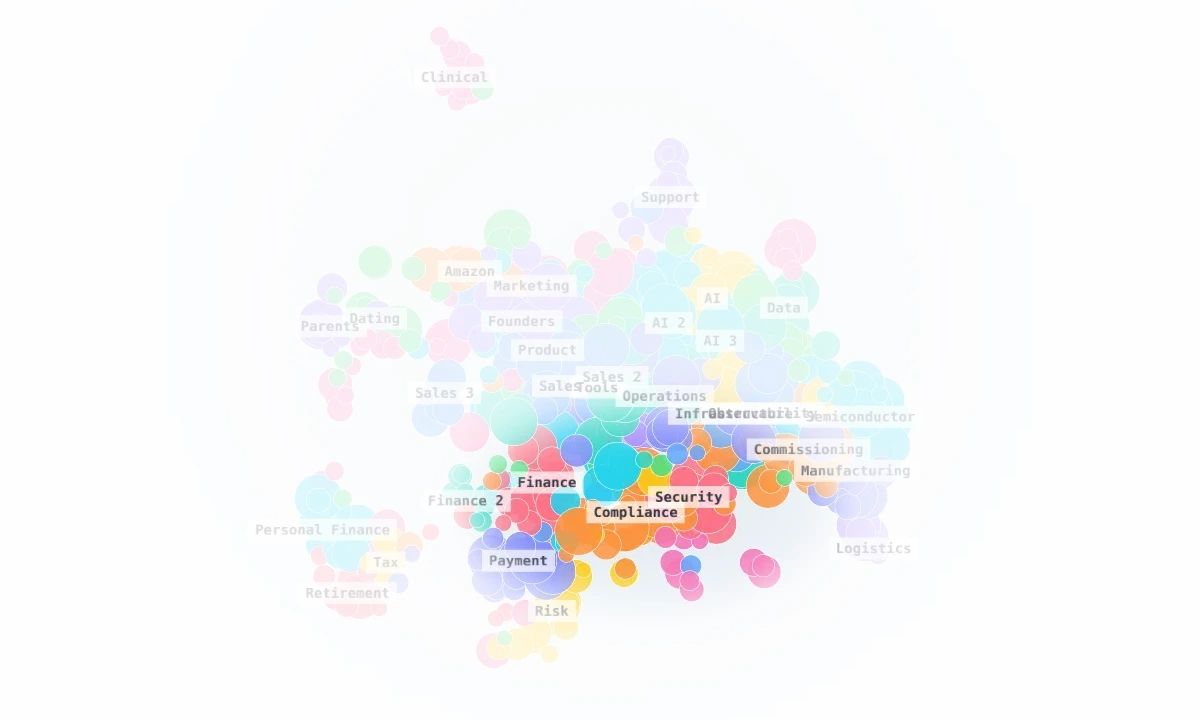
Trend Seeker's Demand Map snapshot from August 3, 2026 contains 197 compliance-readiness ideas connected to 3,564 distinct logical signals. Three overlapping opportunity patterns stand out: launch and regulatory operations, controls and audit evidence, and customer assurance or identity operations.
What the Demand Map says now
This analysis uses the intersection of the Security business ideas sector and region 19, Compliance Gaps. The region groups ideas around audit, controls, governance, regulatory work, safety, identity, and evidence. The Security filter keeps the article focused on work where implementation and proof matter.
| Measure | August 3 snapshot | Definition |
|---|---|---|
| Relevant ideas | 197 | Distinct ideas in both the Security sector and Compliance Gaps region. |
| Distinct logical signals | 3,564 | Evidence deduplicated by source kind and logical signal key across the subset. |
| Idea-signal matches | 3,669 | Connections between ideas and signals. One logical signal can support several ideas. |
| Distinct source URLs? | 2,877 | Unique public URLs? among deduplicated signals that include a URL?. |
| Fresh logical signals | 116 in 7 days 716 in 30 days | Most recently observed inside exact windows ending at the snapshot time. |
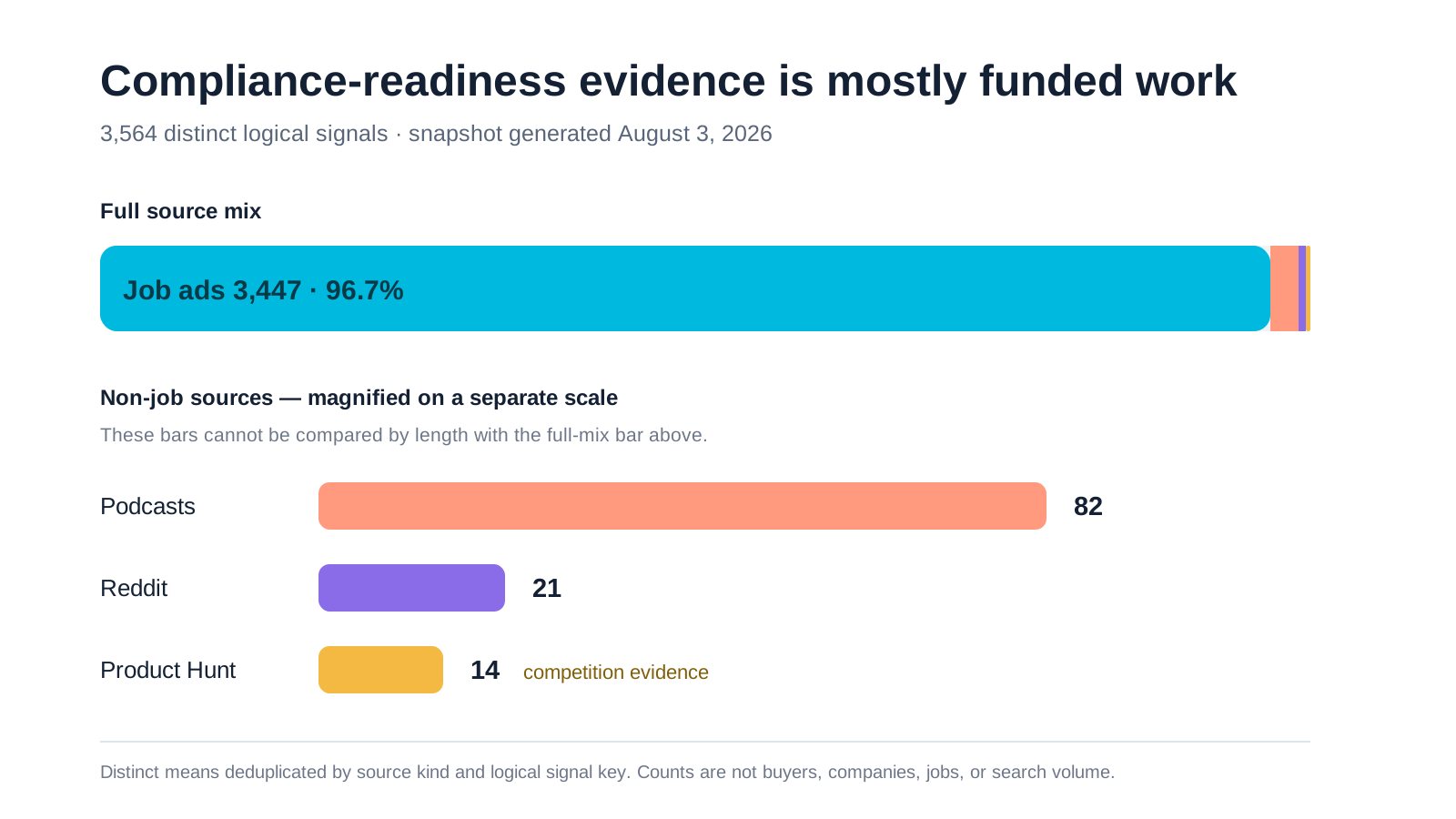
The source mix is the main limitation and one of the most useful findings. Job ads contribute 3,447 of the 3,564 logical signals. Podcasts contribute 82 and Reddit contributes 21. The remaining 14 Product Hunt records describe launches, so this article treats them as competition evidence rather than customer demand.
The non-obvious finding: compliance is an evidence operation
Compliance advice explains what a requirement means. Readiness work makes the requirement observable inside a real company. It connects the requirement to a process, system, owner, test, exception path, and current artifact.
The distinction matters because a policy document can exist while the control fails in practice. The US Securities and Exchange Commission's internal-control reporting rule makes management responsible for establishing, maintaining, and assessing internal control over financial reporting. The Public Company Accounting Oversight Board's AS 2301 describes testing through procedures such as inspection, observation, inquiry, and re-performance. A checklist alone is not operating evidence.
The workflow below shows where a focused service can enter. It can map the scope, install a control, collect evidence, run a test, or manage exceptions. The buyer still owns the decision and remains accountable for the program.
Three compliance service patterns
The theme filters overlap. Their counts describe three lenses over the same 197 ideas and must not be added together.
1. Product launch and regulatory operations
Forty-six ideas match launch, market-expansion, certification, or regulatory language. The leading example is a regulated product launch compliance office connected to 565 idea-level signal matches.
The painful handoff is between legal interpretation and product delivery. A team must turn an obligation into product requirements, controls, sign-offs, filings, renewals, evidence, and an exception path. That work appears across fintech, crypto, telecom, health, AI, and other regulated products.
A small specialist should choose one product and jurisdictional path. The first offer might be a launch control matrix, evidence plan, owner map, readiness review, and first-30-day operating calendar. It should explicitly exclude legal opinions, regulatory approval guarantees, and any licensed work the provider cannot perform.
2. Controls, testing, and audit evidence
This is the broadest theme: 167 ideas match audit, evidence, control, SOX, or testing language. Examples include a SOX readiness control documentation service, a security controls implementation and evidence service, and a co-sourced controls testing desk.
The deliverable is not a folder of generic templates. It is a bounded operating record: current process narratives, named owners, configured controls, test procedures, samples, exceptions, remediation status, and an index that connects evidence to the relevant control and period.
Some of this can become software. NIST's draft IR 8011 methodology identifies security controls that can be assessed with automatable tests for continuous monitoring. That supports a narrow automation thesis. It does not mean every control can be tested automatically or that a dashboard replaces judgment.
3. Customer assurance and identity operations
Fifty-four ideas match customer-security, questionnaire, IAM, identity, or access language. A customer security assurance desk has 155 idea-level matches. Related ideas cover security questionnaires, evidence packs, trust-center upkeep, access reviews, onboarding, offboarding, and privileged-access operations.
The buyer trigger is often commercial. A customer review blocks a deal, a renewal requires updated proof, or a growing team cannot keep identity evidence current. The service sits between security engineering, legal, sales engineering, IT, and the customer.
This wedge is easier to sell when the provider defines response time, approved source material, escalation rules, evidence freshness, and the systems in scope. Avoid writing answers the underlying controls cannot support. Faster questionnaires are useful only when the evidence is accurate.
Five offers a specialist can test
| Offer | Buyer trigger | Evidence delivered | Important limit |
|---|---|---|---|
| Launch compliance operations pack | A regulated product or market launch has a fixed date | Control matrix, owners, sign-offs, evidence index, and operating calendar | Not legal advice or approval assurance |
| SOX process documentation sprint | A finance team approaches its first public-company control review | Scoped narratives, risks, controls, owners, evidence standards, and gaps | Management retains assessment responsibility |
| Security control implementation | The policy exists but access, endpoint, logging, or backup controls do not | Configured controls, test records, exception list, and handover runbook | Tool configuration is not certification |
| Customer security assurance desk | Questionnaires and evidence requests slow enterprise deals | Approved answer library, evidence pack, ownership map, and escalation log | Answers must match operating reality |
| Co-sourced control testing | An internal team cannot run the full recurring test calendar | Walkthroughs, samples, test results, deficiencies, and remediation tracking | Independence and reliance rules need review |
Why this matters now
The opportunity is not based on one rising phrase. Trend Seeker's current Search Console data contains a small set of related impressions, including nine for compliance-ready hardware for design engineers, four for compliance and safety operations services market, and two for fractional compliance. These are internal search-performance observations, not public search volume or proof of a large market.
Current search results are crowded with audit-readiness firms, GRC platforms, certification guides, and generic compliance pages. A definition article would add little. Trend Seeker can contribute a different answer: which operating jobs recur, how the evidence is distributed, and how to turn one recurring job into a bounded first offer.
The rendered Google Trends helper was run for compliance consulting, audit readiness, SOX readiness, and compliance as a service across worldwide five-year and three-month windows. It returned no usable rendered index values for this run, so this article reports none. Google Trends would be a relative 0–100 interest index, not search volume or a Demand Map count.
What the evidence does not prove
The 3,564 logical signals are not 3,564 buyers, jobs, companies, or searches. There are 3,669 idea-signal matches because one logical signal can support several related ideas. The 2,877 distinct source URLs? are another measurement. None of these figures is a market-size estimate.
Job ads make up 96.7% of the subset. They show that companies allocate budgets and people to compliance work. They do not prove that those companies want an outside firm, can share the necessary systems and evidence, or will trust a new vendor.
Compliance also has hard boundaries. Licensing, legal privilege, auditor independence, data access, professional liability, and sector-specific rules can change what a provider may do. A founder should get qualified advice for the exact offer and market. Never promise certification, regulatory approval, a clean audit, or guaranteed compliance.
A 30-day validation plan
- Choose one deadline. Start with a launch, first audit, renewal, customer review, or recurring access test.
- Interview the owner and the evidence producer. They are often different people. Ask what failed during the last cycle and where the record went stale.
- Inspect real artifacts. Review a control matrix, request list, questionnaire, exception log, process narrative, or evidence folder under a clear confidentiality agreement.
- Sell a bounded readiness sprint. Define the framework, systems, period, test method, deliverables, exclusions, and decision owner before work starts.
- Automate only the repeated step. Build collection, reminders, mapping, status, or reporting after several paid engagements expose the same workflow.
Compare these offers with the live Security, FinTech, and Consulting business ideas. The job-ad signal guide explains what hiring evidence can and cannot prove. The startup validation guide covers the next step: testing whether a specific buyer will pay.
Methodology
This analysis uses Demand Map version 9d820f5e-dc4a-4b42-814a-117f40a08eda, generated at 23:30 UTC on August 3, 2026, with source data through 22:22 UTC that day. The snapshot was under two days old when the claims were checked.
We selected ideas classified in the Security sector and region 19, Compliance Gaps. A distinct logical signal is deduplicated by source kind and logical signal key across that subset. An idea-signal match is one relationship between an idea and a signal. A source URL? is one public evidence location. Product Hunt records are reported separately as competition evidence.
The three theme counts use transparent, case-insensitive term groups across title, problem summary, and categories. Launch and regulatory operations match launch, market expansion, certification, or regulatory terms. Controls and evidence match audit, evidence, control, SOX, or testing. Customer assurance and identity match customer security, security review, questionnaire, IAM, identity, or access. The themes overlap and must not be summed.
We reviewed the highest-signal ideas and representative public records, current GSC? queries, rendered Google Trends attempts, current search results, existing Trend Seeker pages, and the primary sources below. GSC? impressions and Google Trends indices were not used as demand counts.
Sources and further reading
- US SEC: Management's Report on Internal Control Over Financial Reporting
- PCAOB AS 2301: The Auditor's Responses to the Risks of Material Misstatement
- NIST IR 8011 draft: Testable Controls and Security Capabilities for Continuous Monitoring
- Representative public evidence: Microsoft security assurance role
- Representative public evidence: Applied Materials internal audit role
- Trend Seeker: current Compliance Gaps Demand Map
Ready to find your next business idea?
Explore validated business ideas backed by real user demand.